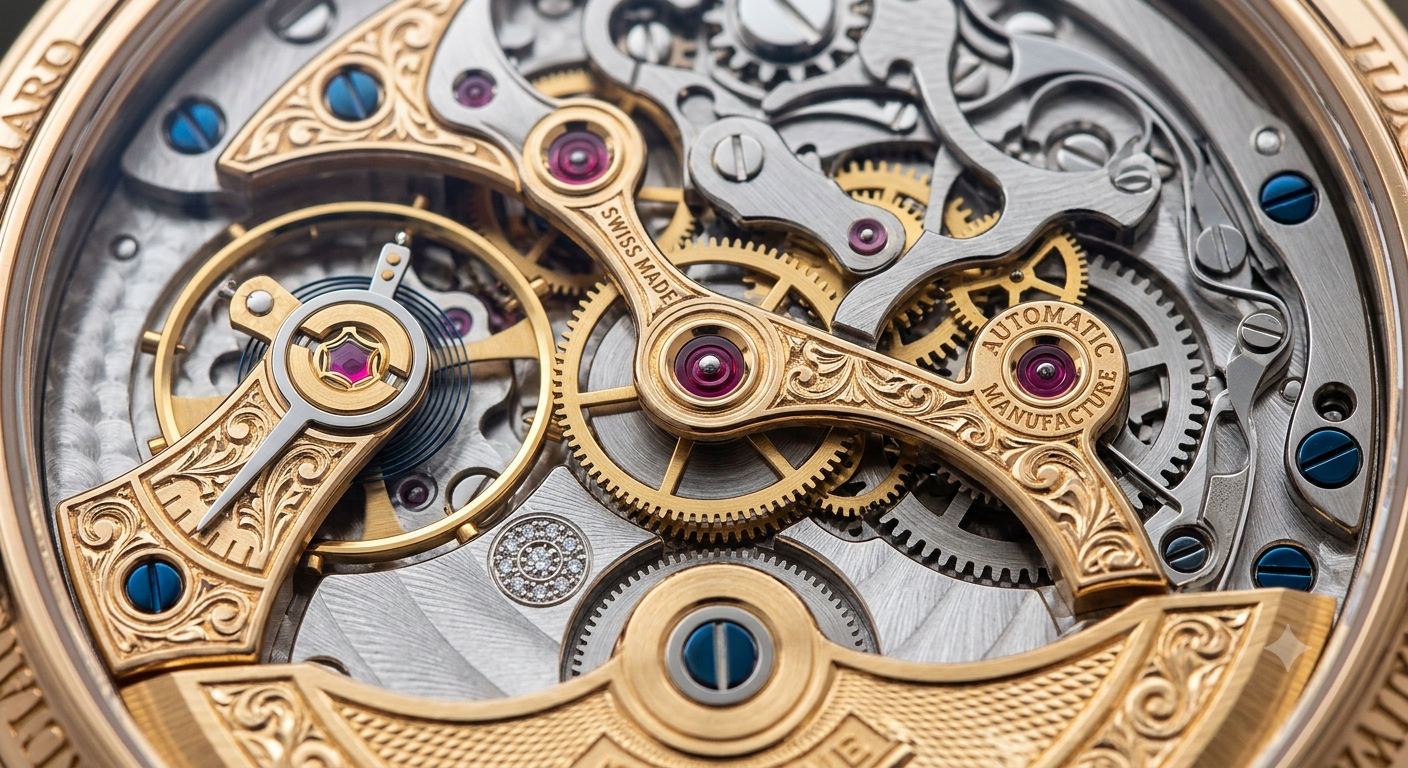
There’s no battery in there
Pop the back off an automatic watch and you’ll find something that looks like it belongs in a clockmaker’s fever dream: tiny golden gears, red jewels, a spinning weight, all moving in perfect rhythm. No chip. No battery. No charging cable.
It runs on physics. Specifically, on a coiled spring — the same basic idea as a wind-up toy car, except assembled by someone with the patience of a monk and the eyesight of a hawk.
How it actually works
Here’s the chain of events every time your watch ticks:
The mainspring is a thin ribbon of metal, coiled tightly inside a small drum. When it’s wound, it wants to uncoil — and that stored tension is the watch’s only source of energy. No Wi-Fi required.
The gear train translates that energy into motion, stepping it down through a series of tiny gears until it reaches the hands.
The escapement is the clever bit — and the one that sounds like it belongs in a heist movie. Without it, the mainspring would uncoil all at once and spin the hands into a useless blur. The escapement releases the gear train in tiny, controlled ticks: exactly 6 to 8 per second. That tick-tock sound? That’s the watch catching its breath.
The rotor is a semicircular weight that swings freely as you move your wrist, automatically winding the mainspring. That’s the “automatic” in automatic watch. You wear it, it winds itself. Go for a walk, you’re basically charging it.
The whole system fits inside a disc about the size of a pound coin and is typically 3–5mm thick. It is, objectively, ridiculous. In the best possible way.
Why does it cost so much?
Because someone built it by hand. Under a microscope. With tweezers.
The tolerances in a watch movement are measured in microns — thousandths of a millimetre. A single gear might have 120 hand-cut teeth. The jewels (usually synthetic rubies) are friction bearings that keep the pivots from wearing out. Every surface is polished, bevelled, or decorated — not because it affects accuracy, but because watchmakers have been trained this way for generations and they simply refuse to stop.
A mid-range Swiss automatic might take 200+ hours of skilled labour to produce, with over 200 individual parts. A high-end one can have 500. Some of those parts are so small they’re invisible to the naked eye and can be lost by a sneeze.
The numbers, side by side
| Automatic | Smartwatch | |
|---|---|---|
| Power source | Your wrist moving | Daily charging |
| Accuracy | ±5 sec/day | Atomic-synced, perfect |
| Lifespan | 50–100 years (with servicing) | 3–5 years |
| Notifications | None. Bliss. | Everything. All of them. |
| Craftsmanship | 200+ hours by hand | Factory floor |
| Water resistance | Often yes | Also yes, but check the fine print |
Neither is objectively better. They solve entirely different problems — one of which is “I would like to know the exact time synced to an atomic clock” and the other is “I would like to own something beautiful that my grandchildren can wear.”
Why buy one when your phone tells the time?
Here’s the thing: nobody needs a watch. Your phone tells the time. Your microwave tells the time. The oven tells the time (badly, but still).
People buy automatics for the same reason they buy a handmade chair when IKEA exists, or a vinyl record when Spotify is free. The object means something. It was made by someone who trained for a decade to build things this small, this precise, this quietly extraordinary.
A good automatic will outlive you. It doesn’t get deprecated. It won’t stop working because a company shut down its servers. It needs a service every 5–10 years — about as demanding as a houseplant that tells time.
There’s also something genuinely humbling about wearing a machine this complex on your wrist. Every time the seconds hand sweeps past, that’s 200 parts working in concert, powered entirely by you moving through your day.
The honest answer
An automatic watch is a terrible timekeeper compared to a smartwatch. It drifts a few seconds a day. It has no GPS, no step counter, no “time to stand up” reminder. It cannot order your coffee.
What it has is 200 moving parts, assembled by a human who trained for years to do it, in a tradition that stretches back centuries.
If you want utility — get a smartwatch. It will absolutely win on specs.
But if you want something to wind, wear, and quietly wonder at? An automatic is unlike anything else you can put on your wrist. It’s the kind of object that makes you slow down for a second and think: someone made this.
And that, it turns out, is worth quite a lot.